Summer of Math Exposition
Presented by  3blue1brown
Archive
Rank 68
Calculus Related Rates Visualizer (Filling of a Cone)
A lot of students struggle to see all of the moving parts of a differential equation. This visualizer takes one very common related rates problem (the filling of a cone) and animates the graphs and scenario to help students intuitively understand how rates and values are interconnected. When one value changes, all the other values change. And the rates at which they change are connected through the differential equation (which can be derived using implicit differentiation).
Rank 69
Graph Learn
An interactive visualization app for mathematics, designed to make you learn through knowledge graphs.
Rank 70
Function Warping
This little explainer shows how, instead of graphing a function directly to the x-axis, one can first graph an auxiliary axis function, and then graph a warped function (a misnomer as most likely, our warped function is not a function) onto that. While this doesn't really involve any hard hitting mathematics, I found the concept neat and wanted to share it with the world.
Rank 71
Understanding the Unit Circle
In this presentation (note: please put the presentation in slideshow mode), I'll cover a few key concepts behind the Unit Circle. Then, we'll create our own Unit Circle, and use it to identify sin, cos, tan, csc, sec, and cot of given angles on the circle. I'll give a step-by-step breakdown on how to build the Unit Circle, as you watch it come to fruition. I've added voiceovers to the presentation to provide some guidance and clarity so viewers can better understand the concepts I'll be explaining. By the end of the presentation, you will understand the concepts behind the Unit Circle, and be able to create one on your own by using the steps in this guide. The Unit Circle is a pertinent mathematical concept, and understanding in today will streamline your learning experience tomorrow.
Rank 72
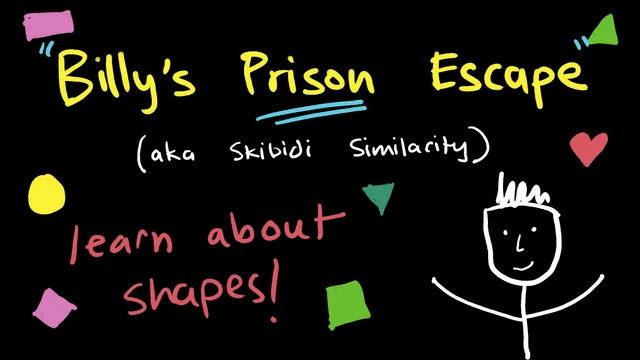
Billy's Prison Escape - A Geometrical Game
We’ve gamified the elementary logical reasoning that underpins mathematical proof, and wrapped it in a bite-sized, memorable narrative. Players wander a strange room of shapes, probe the scene, and — through curiosity, trial-and-error, and a cranky sidekick— slowly notice patterns. The game intentionally avoids front-loading rules: players discover the notion of similarity by doing, not by being told, and are rewarded with micro-affirmations that encourage further exploration.
After players stumble onto similarity in the sandbox, the game unlocks a short, formal letter — a friendly, no-nonsense note that lays out AA, SAS, and SSS. The letter translates the player’s informal “these look the same” into concrete, defensible statements about equal angles and proportional sides, gives clean proof templates, and points to which in-game clues map to which formal conditions. It’s concise and readable by design: not a lecture, but a practical bridge that turns intuition into the language and structure of real mathematical proof.
The design emphasizes autonomy, low friction, and reproducible learning. By blending investigative gameplay with a short, targeted lesson, we give learners a memorable route into why similarity works—and equip them with the actual proof tools they’ll need to use it. This project is compact, learner-focused, and meant to fit both as an entertaining microgame and as an educational bridge from intuition to formal reasoning.
This game was made by two self-taught high-schoolers with no previous experience, little to no mental bandwidth (thank you exams!) and very short time. But we had tons of fun making this and it was certainly a very good learning (and humbling!) opportunity.
Rank 73
Derivative Interactice Visualiser
A p5.js interactive visualizer
Click Animate and watch left and right secant slopes evolve toward any chosen x₀:
🟠 slopeL 🔵 slopeR
• Slopes merge → derivative exists (if finite)
• Slopes stay split or diverge → corner / cusp / opposite infinities
Live trace + stacked histogram = instant view of Persistence vs Divergence.
Rank 74
The Zeta Functions of Fermat Curves: A look at Weil's 1949 paper.
For a long time, I’ve been very interested in the 1949 paper "Numbers of Solutions
to Equations in Finite Fields" by Andre Weil, in which Weil derives explicit
formulae for the number of points of a Fermat hypersurface over a finite field. It is both interesting on its own, and as history. As history, the results of this paper are what lead Weil to conjecture his "Weil conjectures". However, even in a post-Weil conjecture proven world, having a class of varieties with explicit knowledge of their zeta functions is very nice- these varieties especially give a good view into the general theory of the motives of Hecke characters, which is not something I will touch on, but the interested reader should look at the incredible book "On the Periods of Hecke Characters" by Norbert Schappacher.
Primarily, these notes will only be understandable to people with a decent number theory/abstract algebra background. I tried though to make it accessible to a more general audience, but that is still the main audience.
Rank 75
Exponentiable locales, revisited
Given two topological spaces, the construction of the space of continuous functions between them is usually very technical. The more so for the version using locales in pointfree topology. Here we give a moderately motivated exposition, aimed at an audience who knows basic concepts in locale theory, but without any knowledge of exponential spaces or locally compact locales.
Rank 75
On a Property of Magic Squares
A deep dive into the squared magic square problem and a potential solution to brute force cumputation of the problem, presented as a formal mathematics paper.
Rank 76
Interesting Math from the Congressional Record
What if there were an easy way to get some numbers and information from recent bills, and cut through the hype to make some interesting mathematical observations? This might be useful for those who are studying law or mathematics – or anyone wanting to dig through the numbers in recent law. With some basic PHP we can build something that easily processes and shows which might be the most interesting for mathematicians.
(Scroll to the bottom of the blog post if you just want to use the online tool)
Rank 77
Pólya's enumeration theorem
How many ways can you colour an 8x8 grid using two colours, considering two colourings as the same if one can be obtained from the other by a rotation or reflection of the grid? In this essay, I present Pólya’s enumeration theorem, which provides a systematic method for answering such questions. I wrote it as part of my university coursework so it is aimed at undergraduate students familiar with basic group theory and combinatorics.
In particular, in Example 2.2, I present a new solution to a slight variant of an interesting enumeration problem studied by 3Blue1Brown in his 'Olympiad Level Counting' video: namely how many subsets of {1, 2, ..., 2025} have sum divisible by 5?
Rank 77
Building Intuition with Layers of Bricks
Brick walls are among the oldest and most trusted forms of construction. They offer strength, durability, and aesthetic appeal. Yet, even the most solid-looking brickwork is not immune to cracks. To the casual observer, cracks might look random and unpredictable. However, both engineering and mathematics tell us that cracks follow patterns and rules. By studying these patterns, we can gain a deeper understanding of how and why walls fail, and even develop mathematical models to describe the relationship between crack length and the depth of penetration into the wall.
Rank 78
Quantum Circuit Builder
Intuitive Builder of Quantum Circuits. Project provides lots of import features like:
• Vizualization and simulation of qunatum circuits
• Display of qubit states, including the Bloch sphere
• Calculation and visualization of measurement probabilities and phases
• The ability to add comments directly into the circuit
• Saving and reloading of projects
• Creation of custom quantum gates
• Detailed information on gates, including their matrix representation
• Option to turn on noise simulation - simulating decoherence and noise from real world
• Generating Qiskit and QASM code from your circuit
The project thus combines educational functionality with a practical tool for learning and experimenting in the field of quantum information.
Rank 79
Physics taught me I was counting wrong
This is about counting. Yes the same counting you learned probably as your first ever math lesson. Except this is a bit adult stuff where your intuition will be pushed to the limit. It is a math article although a good portion of it toes the line between math and physics. However it is written as a standalone math article. So besides the obvious demographic, I very much intended this for physicists too. If you are a mathematician reading this and have a physicist friend, please make sure your friend reads this. As for the rest, anyone who enjoys critical thinking, you are more than welcome to read.
Rank 80
Principles and laws of physics and science
I describe fundamental laws of physics, and how Albert Einstein and Paul Dirac used logic an simplicity when deriving their equations, and the Lagrangian.
Rank 81
Checking if numbers are Prime using the Miller-Rabin test and Python code to simulate it
The Miller-Rabin test is a highly accurate primality test with a rate of making error 1 in a million. It is based on Fermat's Little Theorem and was made by George Miller who was helped by Michael Oser Rabin. It divides the exponent in the modulus equation in Fermat's Little Theorem by 2 and does this until the exponent is odd. It then checks where there is a 1 the number before it is 1 or n-1(n the number that you want to check). In my Python implementation of the Miller Rabin code I have defined a seq that is empty but gets the modulus of a power and the prime number. The code checks the above conditions and returns True and False accordingly.